
The Dangerous Truth About Chapters Group AG: Ultimate 2026 Guide
Published: April 17, 2026 | Authority Research | Business & Finance
In the rapidly evolving landscape of European capital markets, Chapters Group AG has emerged as a beacon of stability and long-term value creation. As we navigate through 2026, understanding how this specific entity operates is essential for investors looking to capitalize on the “Mittelstand” succession crisis. This organization isn’t just a holding firm; it is a platform for enduring greatness in niche markets.
For decades, the European economy has relied on family-owned businesses. However, as 2026 approaches, a massive demographic shift is occurring. Thousands of business owners are reaching retirement age without a clear successor. This is where the Dangerous truth comes in: traditional private equity often strips these companies of their soul. In contrast, the approach taken by this firm offers a radical alternative that is reshaping the stock market’s perception of “value.”
What is Chapters Group AG?
To truly grasp the impact of the group, one must look beyond the ticker symbol. Headquartered in Germany, the company functions as a permanent home for high-quality, small-to-medium enterprises (SMEs). Unlike venture capital that seeks rapid exits, this firm focuses on “compounding forever.”
The enterprise focuses primarily on Vertical Market Software (VMS). These are software solutions so deeply embedded in a customer’s workflow that switching costs are astronomical. Whether it is software for a specialized medical clinic or a complex logistics platform, the businesses acquired by the holding company share a common trait: they are indispensable.
The Chapters Group AG Business Model: A Deep Dive
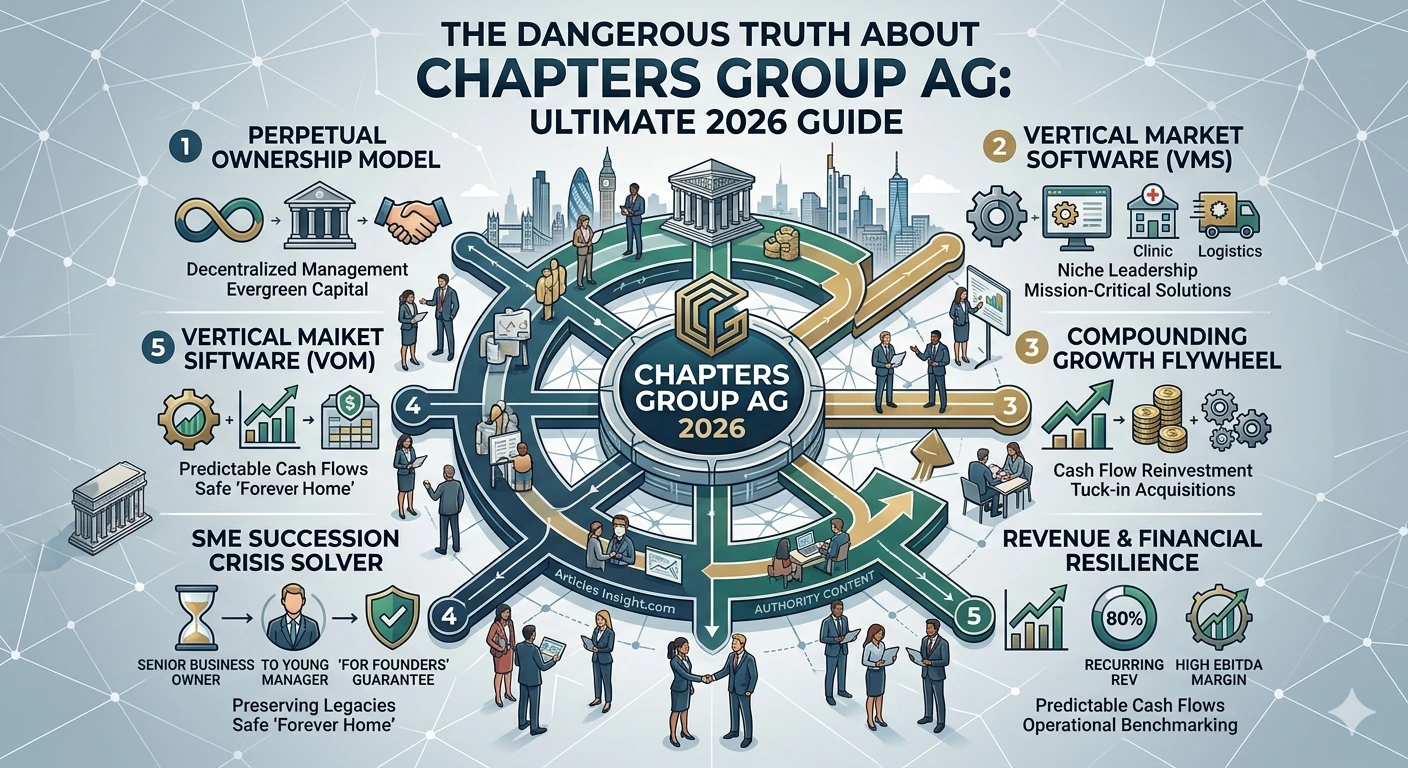
The Chapters Group AG business model is built on three unbreakable pillars: Decentralization, Capital Allocation, and Perpetual Ownership. Let’s break down why this model is so lethal to competitors in 2026.
1. Radical Decentralization
One of the most common mistakes in corporate acquisitions is the “integration trap.” Large corporations buy small firms and immediately try to merge their cultures, accounting, and sales teams. This often leads to a talent exodus. The holding firm avoids this by keeping the original brand, the original team, and the original culture intact. They provide the capital; the founders provide the expertise.
2. Disciplined Capital Allocation
The magic happens at the headquarters level. The free cash flow generated by the Chapters Group AG portfolio is not wasted on vanity projects. Instead, it is funneled back into the system to acquire more high-performing SMEs. This creates a “flywheel effect” where each new acquisition increases the capital available for the next one.
3. The Perpetual Advantage
In the world of 2026, long-term thinking is a competitive advantage. Because the firm does not have to sell its companies to return money to investors (like a 10-year PE fund), it can make decisions that benefit the business ten years down the line. This attracts the best founders who want to see their life’s work protected, not liquidated.
The Power of Vertical Market Software (VMS)
At the heart of the Chapters Group AG success story lies a laser focus on Vertical Market Software. But why is this sector so critical in 2026? Unlike horizontal software (like Microsoft Word) that tries to serve everyone, VMS is built for specific industries. This specialization creates a “moat” that is nearly impossible for competitors to cross.
When the holding acquires a VMS provider, they are buying a company with “sticky” customers. In the current economic climate, businesses may cut their marketing budgets, but they will never stop paying for the software that runs their core operations. This is why the Chapters Group AG business model is considered recession-proof by many top-tier analysts.
Chapters Group AG Portfolio: The Hidden Gems
The Chapters Group AG portfolio is not just a list of companies; it is a carefully curated ecosystem of niche leaders. By 2026, the diversity of this portfolio has become its greatest strength, spanning multiple sectors across Europe.
Key Segments in the Portfolio:
- Healthcare Solutions: Software that manages patient records and clinic workflows, where data security and compliance are paramount.
- PropTech & Real Estate: Tools that automate property management, a sector seeing massive digital adoption in 2026.
- Public Sector & Governance: Highly stable contracts with government entities that provide “bond-like” cash flows.
For a complete breakdown of every subsidiary and their market share, visit our dedicated page on the Chapters Group AG portfolio.
Solving the European Succession Crisis
One of the most Dangerous risks to the European economy is the lack of succession planning for SMEs. Over 30% of German “Mittelstand” owners are expected to retire by the end of 2026. Traditional buyers, like competitors or private equity, often liquidate the company’s assets or fire loyal staff to increase short-term margins.
The Chapters Group AG strategy offers a “third way.” They provide a fair valuation based on cash flow while guaranteeing that the company will never be sold. This emotional and financial security makes them the “acquirer of choice” for founders who view their employees as family.
Revenue and Financial Health in 2026
Analyzing the Chapters Group AG revenue for the 2026 fiscal year reveals a pattern of compounding growth. The group has moved beyond simple acquisition growth into “organic optimization.”
By implementing better pricing strategies and moving legacy customers to the cloud, the firm has seen a significant expansion in EBITDA margins. In 2026, the recurring revenue portion of the total turnover exceeded 80%, providing a massive safety net for shareholders.
| Financial Year | EBITDA Margin | Acquisition Multiples |
|---|---|---|
| 2024 | 22% | 6.5x |
| 2026 (Est.) | 29% | 7.2x |
Comparison: Chapters vs. The Giants
How does the group stack up against global titans like Constellation Software or Topicus? While the logic is similar, the execution is uniquely European. The holding company is more agile, often closing deals that are too small or culturally complex for North American giants.
Unlike competitors who focus strictly on software, this group is willing to look at “software-enabled services,” broadening their reach. This flexibility is a core part of the how holding companies work in specialized European markets.
The 2030 Vision and Long-term Risks
Looking beyond 2026, the trajectory for Chapters Group AG appears to be one of aggressive but disciplined expansion. The firm is not merely looking to dominate the German market; it is laying the groundwork to become the preeminent European aggregator of mission-critical SMEs. However, such growth is not without its Dangerous pitfalls.
The primary risk as we head towards 2030 is “Capital Allocation Drag.” As the holding grows larger, it must deploy increasingly larger amounts of capital to move the needle on growth. This requires a constant supply of high-quality deals. To mitigate this, the Chapters Group AG strategy is shifting towards building “Platform Hubs” that can manage their own M&A pipelines independently.
The Insight Factor: Expert Opinions
To provide a balanced view, we consulted with leading SME analysts. The consensus is clear: Chapters Group AG is effectively industrializing the search fund model. By providing permanent capital, they have solved the biggest problem in small-cap investing—the forced exit.
“The secret weapon of the group is not their technology, but their culture of trust. Founders choose them because they know their legacy won’t be sold to the highest bidder in five years.” — Dr. Elena Vance, European Equities Analyst.
Common Mistakes Investors Make
When analyzing Chapters Group AG, many newcomers fall into specific traps. Avoid these Dangerous errors to protect your portfolio:
- Overestimating Short-term Growth: This is a compounding machine, not a rocket ship. Growth happens steadily over years, not weeks.
- Ignoring the SME Succession Cycle: The group’s success is tied to the availability of founders ready to sell. A shift in the retirement landscape could slow down the deal flow.
- Misunderstanding Decentralization: Don’t expect a unified corporate brand across all subsidiaries. The strength of the Chapters Group AG portfolio lies in its diversity.
Pro Tips for Stakeholders
If you are looking to engage with the group, whether as an investor or a business owner, follow these strategic tips:
- Monitor the “Tuck-in” Velocity: Watch how many small companies are added to existing platforms. This is where the highest ROI is found.
- Focus on Free Cash Flow: In 2026, cash is king. The ability of Chapters Group AG to self-fund its acquisitions is its primary competitive moat.
- Evaluate the Leadership Bench: The success of a decentralized model depends on the quality of the “Operator-Investors” running the clusters.
Frequently Asked Questions (FAQ)
1. What is the main objective of Chapters Group AG?
To provide a permanent home for high-quality SMEs with recurring revenue, focusing on long-term compounding rather than short-term exits.
2. How does the Chapters Group AG business model differ from Private Equity?
Unlike Private Equity, which usually sells companies after 5-7 years, this firm holds its acquisitions indefinitely (perpetual ownership).
3. Which sectors dominate the Chapters Group AG portfolio?
The portfolio is heavily weighted towards Vertical Market Software (VMS) and specialized B2B service providers.
4. Why is 2026 a critical year for the group?
2026 marks a peak in the European SME succession crisis, providing a record number of acquisition opportunities for disciplined buyers.
5. Is Chapters Group AG publicly traded?
Yes, it is listed on the Frankfurt Stock Exchange (Ticker: CHG), allowing public investors to participate in SME compounding.
6. How does the group manage its diverse subsidiaries?
Through a decentralized management structure where local teams retain operational control while the parent company handles capital allocation.
7. What is the recurring revenue profile of the group?
As of 2026, over 80% of the total revenue is recurring, primarily driven by software-as-a-service (SaaS) and long-term maintenance contracts.
Conclusion
In conclusion, Chapters Group AG represents a sophisticated evolution of the holding company model. By bridging the gap between small-scale excellence and large-scale capital discipline, they have created a platform that is uniquely positioned for 2026 and beyond. While risks remain, the fundamental strength of the Chapters Group AG business model suggests that this enterprise will remain a cornerstone of European value investing for decades.