
UCAS Clearing 2026: Your Final Chance for UK University Admission
As the primary UCAS Clearing 2026 window opens on July 2nd, the landscape of UK higher education transforms into a high-speed marketplace. For students who didn’t meet the primary UCAS deadlines or those who decided to apply late, Clearing is not a “second-best” option—it is a strategic opportunity to enter prestigious institutions that still have international quotas to fill.
In this definitive guide, we break down the technicalities of the 2026 Clearing process, how to use the New UCAS Personal Statement 2026 to your advantage during phone interviews, and how to secure a CAS in record time.
The Insight Factor: The 2026 “Empty Seat” Economy
Expert Opinion: “In 2026, we are seeing a record number of Russell Group universities entering Clearing for high-demand courses like AI, Renewable Energy, and FinTech. Why? Because global mobility is shifting. If you have your transcripts and English scores ready by July, you could secure a place at a top-50 university that was ‘closed’ in January.”
— Suzan Talat, Lead Admissions Strategist at Articles Insight.
1. What is UCAS Clearing 2026?
Clearing is the system universities use to fill any seats they still have available on their courses. It’s available to you if:
- You are applying after June 30th (The Late Application cut-off).
- You didn’t receive any offers (or none you wanted to accept).
- You didn’t meet the conditions of your conditional offers.
- You have performed better than expected and want to “Self-Release” to find a higher-ranked university.
2. Step-by-Step Clearing Strategy for International Students
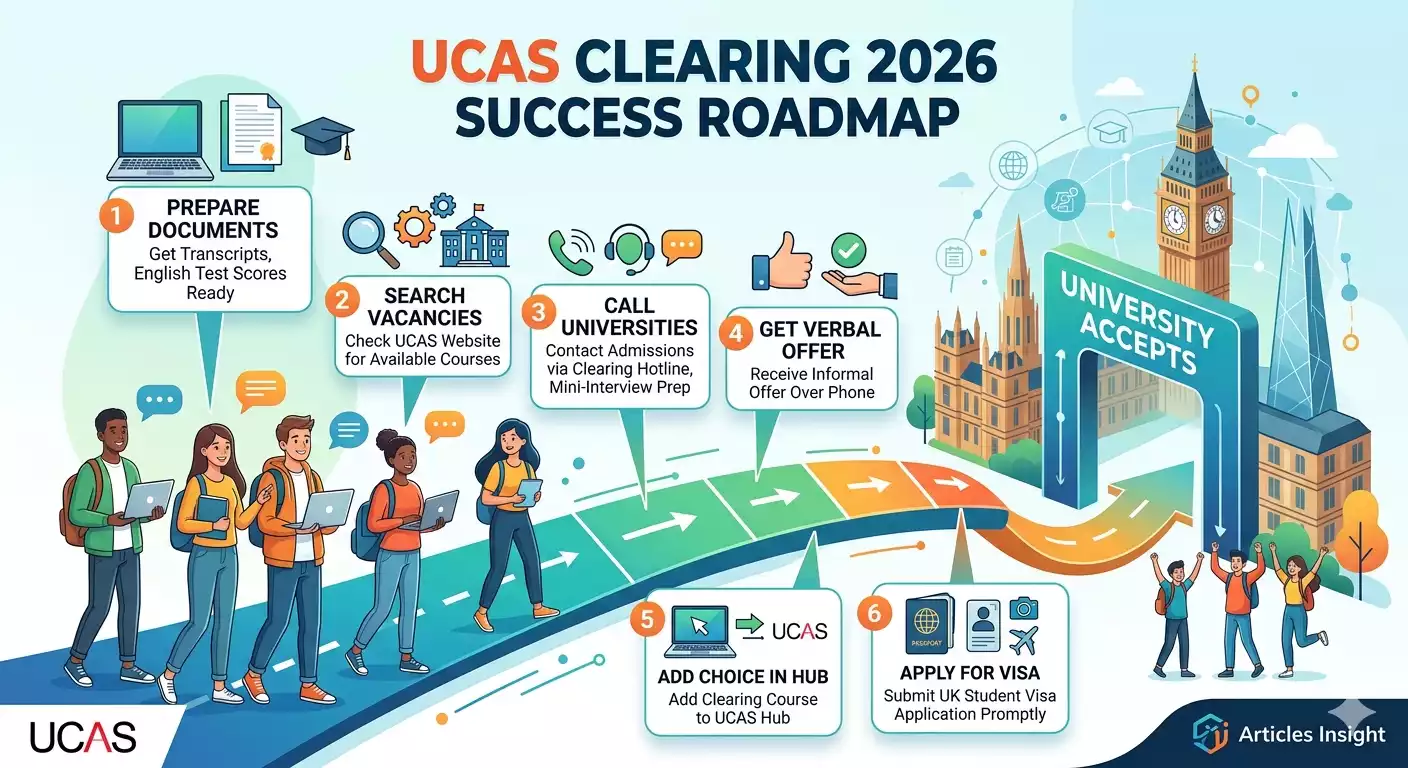
For Arab students and other international applicants, Clearing is a race against time due to visa constraints. Follow this technical roadmap:
Phase A: The Research (June 2026)
Before Clearing officially opens, create a “Shortlist” of universities. Use the UCAS Search tool to see which courses are marked with a ‘C’ (Clearing).
Phase B: The Direct Contact (July 2026)
In 2026, the most effective way to get a Clearing offer is by calling the university’s “Clearing Hotline.” Have your UCAS ID, grades, and English test scores ready. Be prepared for a mini-interview over the phone.
3. The Clearing Interview: Answering the 3 Questions
Even in Clearing, the logic of the New UCAS Personal Statement 2026 applies. When you speak to an admissions officer, they will effectively ask you the three structured questions:
- Why this course now? (Motivation)
- How are you ready to start in September? (Learning)
- What makes you a unique addition to our campus? (Experience)
4. Clearing Fees and Financial Preparation
| Requirement | Standard Entry | Clearing Entry 2026 |
|---|---|---|
| UCAS Fee | Included in initial fee | £28.50 (if not already paid) |
| Tuition Deposit | Standard deadline | Immediate (often within 48 hours) |
| Visa Processing | Standard (3 weeks) | Priority/Super Priority (Recommended) |
How to Ace the UCAS Clearing Phone Interview
In 2026, the UCAS Clearing process is more personal than ever. Many universities will conduct a mini-interview over the phone before issuing an informal offer. This is your moment to shine. Since you have already practiced the logic of the 3 structured questions, you should be ready to answer why you are a perfect fit for their specific academic community.
Top 3 Questions You Will Face on the Hotline:
- “Why did you choose this specific course in Clearing?” – Be ready to link your current grades to their specific modules.
- “What can you contribute to our university diversity?” – Mention your cultural background or leadership skills.
- “Are you ready to start your visa application immediately?” – For international students, showing readiness is key to getting a CAS (Confirmation of Acceptance for Studies) quickly.
Strategic Tips for a Successful 2026 Clearing Choice
Do not settle for the first offer you receive. During UCAS Clearing 2026, you can talk to multiple universities and receive several “informal offers” over the phone. However, you can only add one Clearing choice to your UCAS Hub at a time. This is a critical technical step: only add a choice once you are 100% sure you want to attend that institution.
Furthermore, keep an eye on accommodation. Since you are applying late, university halls might be full. Ask the admissions officer during your call if they have reserved housing for Clearing applicants. This is a common practice in 2026 for universities aiming to attract high-quality international students from the MENA region.
The Importance of “Self-Release” in 2026
If you have exceeded your predicted grades (e.g., getting A*A*A instead of ABB), you are in a position of power. In 2026, you can use the “Self-Release” button in your UCAS Hub to enter Clearing voluntarily. This allows you to apply to higher-ranked universities that were previously out of reach. It is a high-risk, high-reward strategy that requires you to have an informal offer from a better university before you release yourself from your original firm choice.
Conclusion
Navigating UCAS Clearing 2026 requires a mix of speed and strategy. It is the final “Gold Rush” of the academic year. By keeping your documents ready and being proactive on the phone, you can turn a missed January deadline into a September success story. For a refresher on the basics, review our 2026 Deadlines Bible before the summer begins.