

Late UCAS Application 2026: Is It Too Late? (Strategic Recovery Guide)
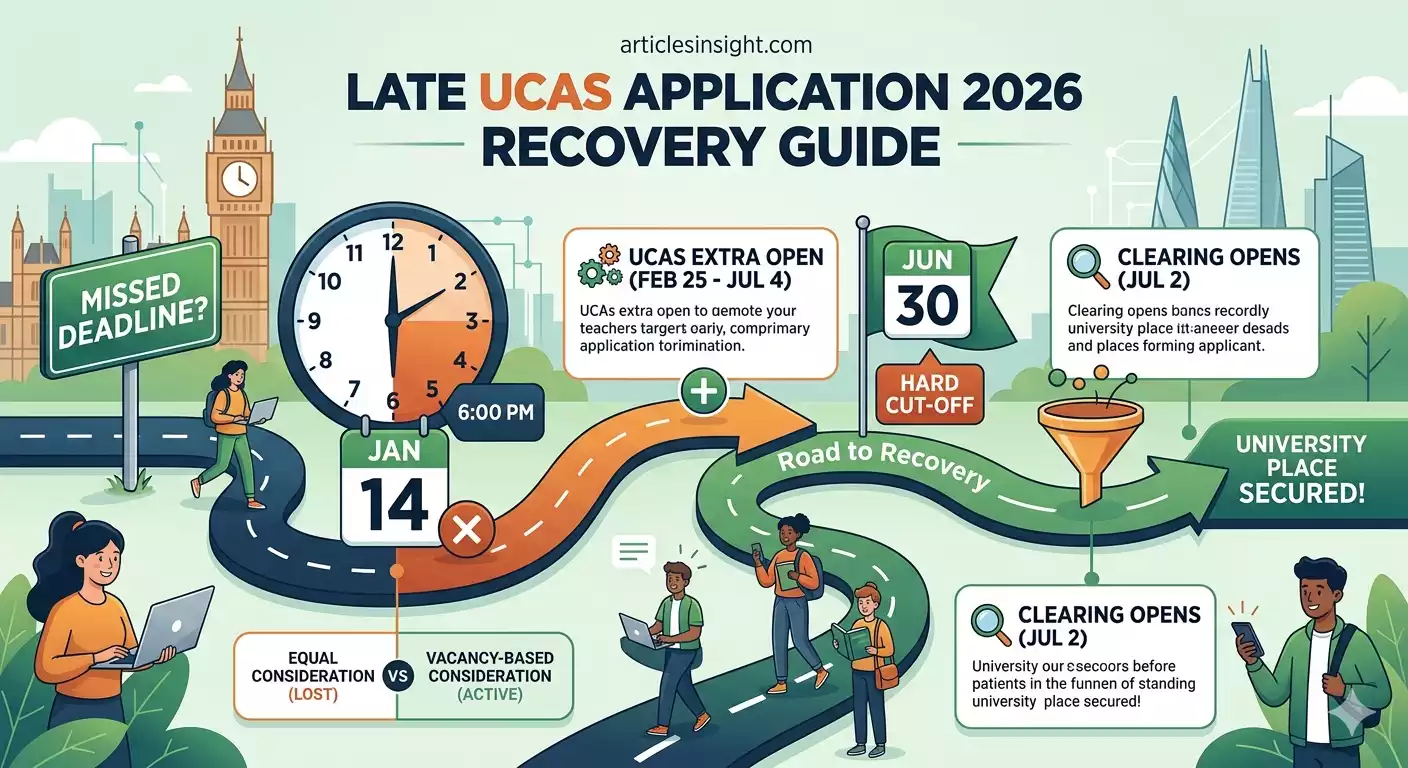
Finding yourself searching for Late UCAS Application 2026 options can be stressful, but it is far from a dead end. While the primary UCAS Deadlines 2026 (specifically the January 14th window) have passed, the UK admissions system is uniquely designed with “safety valves” to accommodate high-quality latecomers. In 2026, due to shifting global demographics, many top-tier universities are keeping their doors open longer than usual.
This strategic manual explores how to navigate the post-deadline landscape, the technicalities of UCAS Extra, and how to adapt the New UCAS Personal Statement 2026 for a late-cycle audience.
The Insight Factor: The “Late” Advantage in 2026
Expert Opinion: “Being a late applicant in 2026 isn’t a disadvantage if you target the right courses. Universities are currently prioritizing ‘diversity quotas’ more than ever. If you have a strong academic profile, applying late can sometimes lead to faster offer turnaround times as admissions offices look to finalize their numbers before the summer.”
— Suzan Talat, Higher Education Specialist at Articles Insight.
1. Understanding the June 30th “Hard” Cut-off
There is a common misconception that January 14th is the final day to apply. In reality, you can submit a Late UCAS Application 2026 up until June 30, 2026 (18:00 UK time). However, there is a catch: Equal Consideration no longer applies.
What this means for you: Universities will only look at your application if they still have vacancies after processing everyone who applied on time. For competitive courses like Medicine or Law, this is a gamble, but for Business, Engineering, and Creative Arts, many seats remain available.
2. UCAS Extra: Your Second Chance (Feb 25 – July 4)
If you applied on time but received no offers, or if you’ve declined the offers you received, you don’t have to wait for Clearing. UCAS Extra is a vital tool in the 2026 cycle.
- How it works: You add one choice at a time through your UCAS Hub.
- The Benefit: It allows you to target universities that have officially declared they still have space before the Clearing madness begins.
3. Adapting the Personal Statement for Late Entry
When applying late, your answers to the three new 2026 questions must be even more robust. Admissions tutors will wonder why you are applying late. Your Section 1 (Motivation) should subtly reflect your readiness to start immediately and your clear focus, despite the delay.
4. Comparison: Main Cycle vs. Late Application 2026
| Feature | On-Time Application | Late Application (Post-Jan 14) |
|---|---|---|
| Consideration | Equal Consideration (Guaranteed Review) | First-come, First-served (Subject to Vacancy) |
| Course Availability | 100% of Courses Open | Limited (Medicine/Oxbridge usually closed) |
| Decision Speed | Can take months | Usually faster (2-4 weeks) |
| Route to Entry | Standard Entry | Extra / Clearing (after June 30) |
5. Recovery Checklist for International Students
If you are applying late as one of the many Arab students targeting the UK, time is your biggest enemy due to visa processing. Follow this checklist:
- [ ] Verify ELP (IELTS/PTE) scores are still valid and meet the requirements.
- [ ] Ensure your academic transcripts are translated and ready for immediate upload.
- [ ] Check the CAS (Confirmation of Acceptance for Studies) issuance deadlines for late applicants.
Official Resources
Conclusion
A Late UCAS Application 2026 is a tactical pivot, not a failure. By using UCAS Extra wisely and keeping an eye on the June 30th cut-off, you can still secure a place at a high-ranking institution. For more details on the final stages of the cycle, visit our Clearing 2026 Guide.




Pingback: UCAS Clearing 2026: Your Final Chance for UK University Admission - Articles Insight
Pingback: UK University Application for Arab Students 2026: Success & Visa Guide - Articles Insight
Pingback: New UCAS Personal Statement 2026: Successful Guide to the 3 New Questions - Articles Insight