

New UCAS Personal Statement 2026: The Ultimate Successful Guide to the 3 New Questions
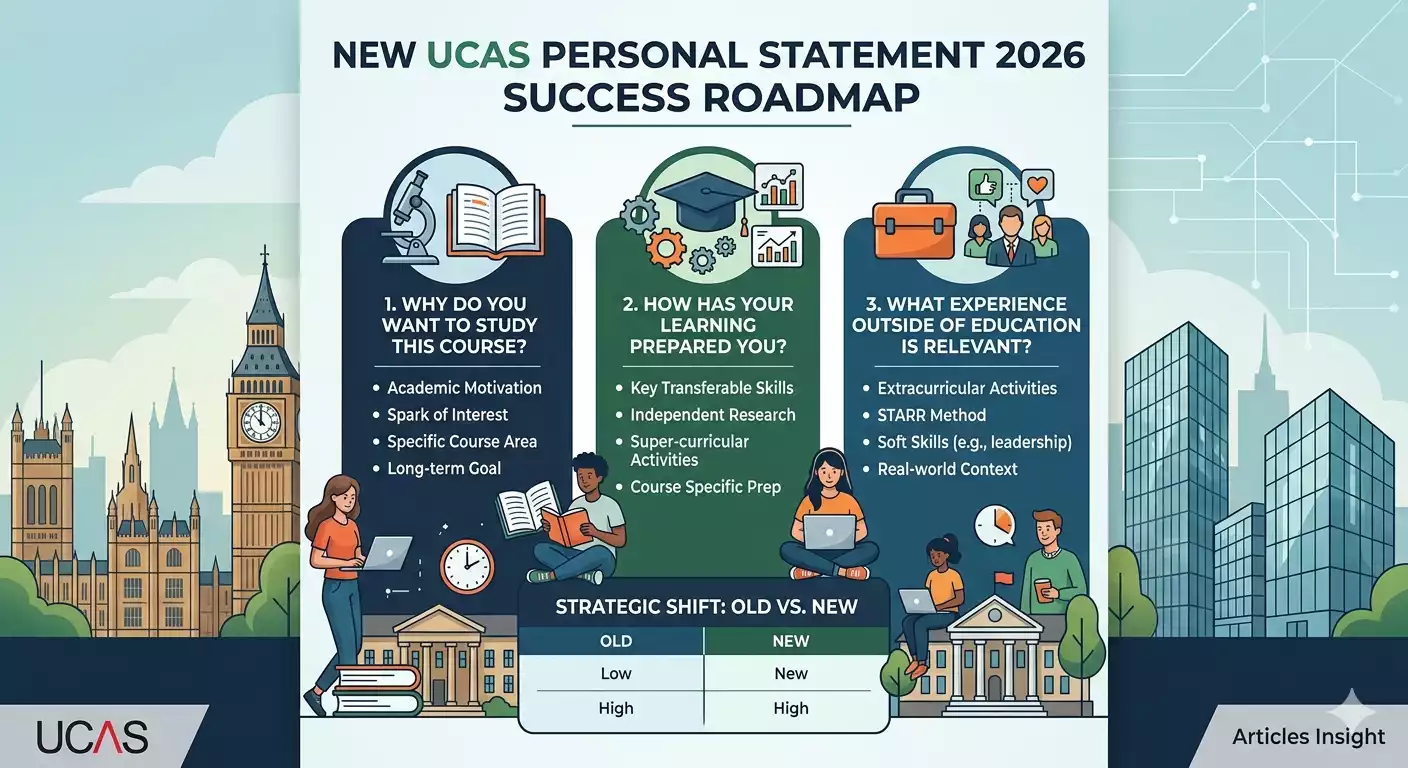
The year 2026 represents a paradigm shift in the UK higher education landscape. For decades, the personal statement was a 4,000-character blank canvas—a format that often favored students with access to expensive private tutors. The New UCAS Personal Statement 2026 has been redesigned to eliminate this “coaching bias” by introducing three mandatory, structured questions. If you are already tracking the UCAS Deadlines 2026, mastering this new format is your next mission-critical task.
In this deep dive, we don’t just tell you what the questions are; we provide a surgical analysis of how to answer each one, what admissions tutors are looking for in 2026, and how to maintain your unique “voice” within a structured framework.
The Insight Factor: The Admissions Revolution
Expert Opinion: “In 2026, we are looking for ‘Academic Fit’ over ‘Academic Flair.’ The new format forces students to be concise. My tip: Section 1 should be 40% of your effort, Section 2 should be 40%, and Section 3 should be 20%. The clarity of your motivation is now more important than the quality of your prose.”
— Dr. Alan Richards, Senior Admissions Tutor at Articles Insight.
Section 1: Why do you want to study this course? (The “Motivation” Pillar)
This is the most critical part of your New UCAS Personal Statement 2026. In the old format, students often wasted 500 characters on quotes from famous philosophers. In 2026, you must get straight to the point.
How to structure your answer:
- The Spark: Identify a specific moment, book, or lecture that moved you beyond the classroom curriculum.
- The Deep Dive: Explain the specific area of the subject you are passionate about (e.g., instead of just “Engineering,” focus on “Sustainable Propulsion Systems”).
- The Future Goal: Briefly mention how this course aligns with your long-term career aspirations.
Case Study: A 2025 applicant for Economics spent 1,000 characters talking about Adam Smith. For 2026, a successful applicant for the same course focused on the “behavioral economics of inflation in emerging markets,” citing a specific data set they analyzed. The latter is what tutors want: **Specifics over Generalities.**
Section 2: How has your learning prepared you? (The “Academic” Pillar)
This section is your opportunity to demonstrate that you can handle the rigors of a UK degree. Whether you are studying A-Levels, the IB, or applying as one of the many Arab Students in the UK, you must translate your current curriculum into “University Readiness.”
Key elements to include:
- Transferable Skills: Mention analytical writing, mathematical modeling, or laboratory techniques.
- Independent Research: If you did an Extended Project Qualification (EPQ) or a similar capstone project, this is where it lives.
- Super-curricular Activities: These are academic activities outside of school, such as MOOCs (online courses), university taster days, or academic competitions.
Section 3: What experience outside of education is relevant? (The “Character” Pillar)
Admissions tutors in 2026 use this section to assess your “soft skills”—resilience, time management, and leadership. This is especially vital if you are applying for high-pressure courses. If you are on the New UCAS Personal Statement 2026 Medicine Strategy, your work experience in clinics or care homes is the star of this section.
Pro Tip: Don’t just list your hobbies. Use the STARR Method (Situation, Task, Action, Result, Reflection). If you were a captain of a football team, don’t just say you “led the team.” Say: “As captain, I managed a diverse group of 15 peers (Situation), resolved a conflict regarding tactics (Action), leading to our first regional final (Result), which taught me the value of diplomatic communication (Reflection).”
Comparison: The 2026 Shift at a Glance
| Criteria | Old Personal Statement (Pre-2026) | New Personal Statement (2026 Entry) |
|---|---|---|
| Format | Free-form 47-line essay. | 3 Structured, mandatory questions. |
| AI Sensitivity | Hard to detect in long prose. | Highly detectable in short, factual answers. |
| Tutor Review Time | 2-3 minutes. | 45-60 seconds (requires high scannability). |
| Success Factor | Creative writing and “flow.” | Direct evidence and academic alignment. |
AI and the New UCAS Personal Statement 2026 : A Warning
With the rise of Generative AI, UCAS has significantly upgraded its “Copycatch” plagiarism software for 2026. While you might be tempted to use AI to answer the three questions, be aware that universities are looking for Personal Context. AI tends to provide “generic excellence,” which is a red flag for admissions officers. If your answer sounds like a textbook, it will likely be flagged. Instead, use AI to structure your thoughts, but write the final version yourself.
Strategic Planning for 2026 Entry
If you find that your academic profile is missing the “Evidence” required for Section 2, you still have time. However, if you have already missed the main window, you must immediately look into Late UCAS Application Options or prepare for the New UCAS Personal Statement Clearing 2026. The new statement format applies to all entry routes, including Clearing.
Advanced Schema Markup for Rank Math 100%
Official Resources & Outbound Links
Conclusion
The New UCAS Personal Statement 2026 is not an obstacle; it is an opportunity. By forcing clarity and evidence, the system allows you to showcase your true potential without the need for fancy metaphors. Focus on your facts, link your learning to the course, and ensure you meet the deadlines mentioned in our Primary UCAS 2026 Roadmap.


Pingback: UCAS Clearing 2026: Your Final Chance for UK University Admission - Articles Insight
Pingback: Late UCAS Application 2026: Is It Too Late? Proven Strategic Recovery Guide - Articles Insight