

Applying to universities in the United Kingdom for the 2026 undergraduate intake is one of the most important steps for any student planning to study in the UK.
Understanding application deadlines is crucial because it ensures you:
- Do not miss your preferred universities
- Have opportunities to apply for scholarships
- Prepare all required documents on time
- Reduce stress and avoid last-minute issues
This comprehensive guide will cover every aspect of UK undergraduate applications in 2026, including UCAS deadlines, early vs regular applications, month-by-month timelines, scholarships, and common mistakes to avoid.
Why Meeting Application Deadlines in 2026 Matters
Top UK universities have strict deadlines, and missing them can result in:
- Losing your chance to enroll for the 2026 academic year
- Missing out on scholarship opportunities
- Delays in visa processing
- Limited program options
Many universities close applications early once seats are filled. Planning early ensures a significant advantage and reduces unnecessary stress.
Understanding UCAS Deadlines
All undergraduate applications in the UK go through UCAS (Universities and Colleges Admissions Service). UCAS manages applications for multiple universities in one platform.
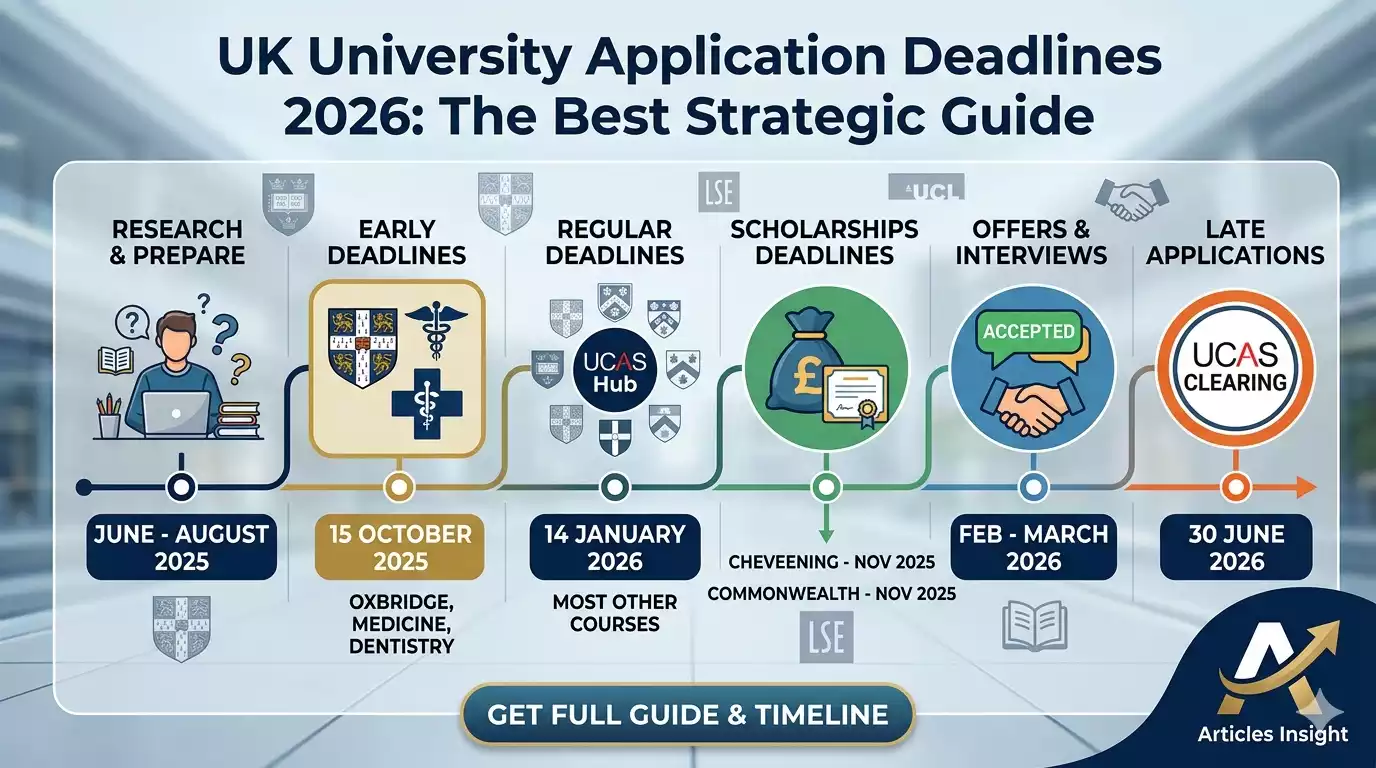
Key 2026 Deadlines
| Course Type | Deadline |
|---|---|
| Oxford and Cambridge | 15 October 2025 |
| Medicine, Dentistry, Veterinary Medicine | 15 October 2025 |
| Most Other Undergraduate Courses | 14 January 2026 |
| Late Applications | 30 June 2026 |
How UCAS Works
- Students submit one application to UCAS for multiple universities
- Each course may have specific entry requirements
- Applications include personal statements, predicted grades, and reference letters
- UCAS sends confirmation emails and application updates
Early vs Regular Deadlines
Early Deadlines (October 2025)
- Applies to competitive courses such as Oxbridge, Medicine, Dentistry, and Veterinary Medicine
- Decisions are usually faster
- Increases chances of acceptance due to limited spots
- Allows more time to prepare for interviews and scholarship applications
Regular Deadlines (January 2026)
- Standard deadline for most undergraduate courses
- Decisions are generally released between February and March 2026
- Students submitting closer to this deadline should ensure all documents are complete to avoid rejection
Tip: Always submit applications at least 7–10 days before the official deadline to avoid last-minute technical issues or missing documents.
Month-by-Month Timeline for 2026 Applicants
| Month | Tasks |
|---|---|
| June–August 2025 | Research universities and courses, prepare personal statements, take required exams (IELTS/TOEFL), and request references. |
| September–October 2025 | Submit applications for Oxford, Cambridge, Medicine, Dentistry, Veterinary courses. Begin early scholarship applications. |
| November–December 2025 | Submit other early applications. Continue preparing for interviews and finalizing documents. |
| January 2026 | Submit most regular applications before the UCAS main deadline. Verify all application components are complete. |
| February–March 2026 | Universities review applications, conduct interviews, and release conditional/unconditional offers. |
| April–June 2026 | Receive offers, compare options, plan accommodation, and manage finances. |
| July 2026 | UCAS Clearing opens for late applicants. |
| August 2026 | Confirm enrollment and prepare for the academic year starting in September 2026. |
Scholarships and Funding Deadlines 2026
Many scholarship deadlines close earlier than main application deadlines. Planning ahead is essential for securing funding.
| Scholarship | Deadline |
|---|---|
| Chevening Scholarship | November 2025 |
| UK University Merit Scholarships | December 2025 – January 2026 |
| Rhodes Scholarship | October 2025 |
| Commonwealth Scholarship | November 2025 |
| University-specific Merit Scholarships | Varies (check individual university websites) |
Pro Tip: Always apply for scholarships as early as possible to increase your chances. Missing a scholarship deadline can cost you thousands in tuition support.
Common Mistakes to Avoid
- Submitting applications at the last minute
- Missing required documents such as references, transcripts, or proof of English proficiency
- Submitting a weak or generic personal statement
- Ignoring specific UCAS or university guidelines
- Failing to check individual university deadlines
- Neglecting to monitor email notifications from UCAS or universities
- Overlooking scholarship deadlines
- Applying to too many or irrelevant courses without focus
- Waiting for predicted grades without planning contingency options
- Not preparing for interviews when required
Rule of thumb: Always complete your application 7–10 days before the official deadline to allow time for verification and corrections.
Frequently Asked Questions (FAQ)
Q1: When do UK university applications open for 2026?
A1: Most UCAS applications open in September 2025.
Q2: What is the latest deadline for 2026 undergraduate courses?
A2: 14 January 2026 for most courses; 30 June 2026 for late applications (Clearing).
Q3: Can I apply after the deadline?
A3: Only through the UCAS Clearing process starting July 2026, but course availability may be limited.
Q4: Are scholarship deadlines earlier than application deadlines?
A4: Yes, many scholarships close 1–3 months before the main UCAS deadline.
Q5: What documents are required for UK undergraduate applications?
A5: Personal statement, reference letters, predicted grades, transcripts, and proof of English proficiency (IELTS/TOEFL).
Q6: How many universities can I apply to through UCAS?
A6: You can apply to up to 5 courses (4 for medicine, dentistry, and veterinary programs).
Q7: How do I track my application status?
A7: Log in to your UCAS Hub account regularly for updates, including offers, interviews, and additional requirements.
Q8: What difference between conditional and unconditional offers?
A8: Conditional offers depend on achieving predicted grades or exam results, while unconditional offers do not have any academic conditions.
Q9: Can I defer my offer to 2027?
A9: Some universities allow deferral requests for one year; always check with the university directly.
Q10: How can I improve my chances of acceptance?
A10: Apply early, tailor your personal statement to each course, ensure all documents are complete, and research scholarships.
Final Tips for 2026 Applicants
- Start your application process as early as possible
- Target 5–8 universities that align with your academic and career goals
- Prepare all documents well in advance, including references and test scores
- Follow UCAS guidelines carefully and monitor your email for updates
- Plan for interviews if required and practice in advance
- Keep track of scholarship deadlines to maximize funding opportunities
- Double-check all application forms before submission to avoid mistakes
- Stay organized with a calendar or checklist to track every task and deadline
Boost Your Admission Chances!
Planning to apply to BNU? Don’t miss our
Strategic Tips for 2026 UK University Applicants
to ensure a successful application.
Official Resources & References
To ensure the accuracy of your 2026 application, we recommend consulting these official UK education authorities:
-
• UCAS Official Website
– The central hub for all UK undergraduate applications. -
• UK Government Student Visas
– Official immigration and visa requirements for 2026. -
• British Council: Study UK
– Global guide for international students planning to study in the UK. -
• Chevening Scholarships
– Official portal for the UK government’s international awards program.



Pingback: City St George’s University of London 2026: The Best Strategic Guide - Articles Insight
Pingback: Lancaster University 2026: The Best Strategic Guide to Success - Articles Insight