
UK University Application for Arab Students 2026: The Ultimate Success & Visa Guide
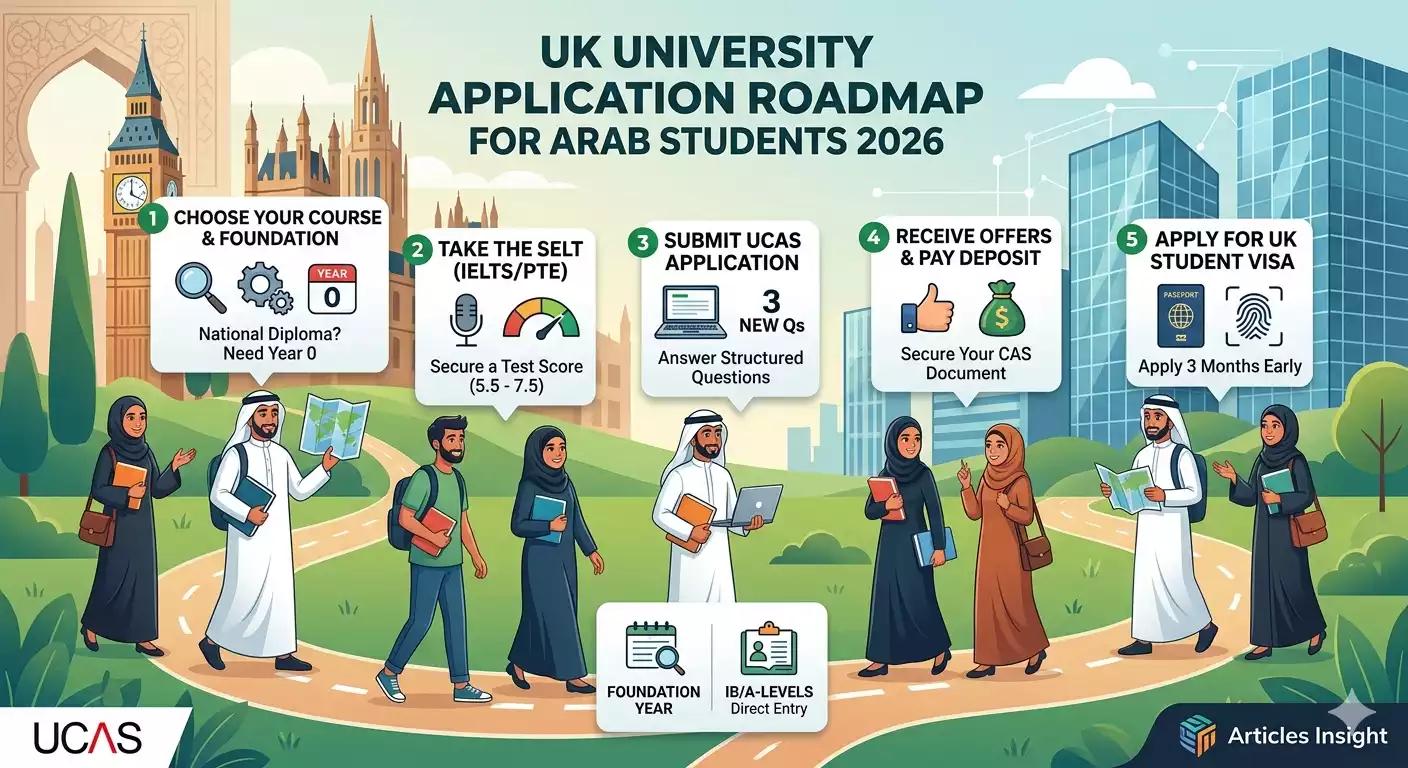
For students from the Middle East and North Africa (MENA), securing a place in a British institution is more than just an academic milestone—it’s a global career launchpad. However, the UK University Application for Arab Students 2026 involves navigating specific financial, linguistic, and immigration hurdles. Whether you are aiming for the primary UCAS deadlines or considering a late application strategy, this guide is built for you.
The Insight Factor: The “Middle East” Pivot in 2026
Expert Opinion: “In 2026, UK universities are increasingly looking to the Gulf and North Africa to diversify their international cohorts. We are seeing a surge in ‘tailored scholarships’ for Arab applicants in STEM and Creative Arts. My advice: Focus heavily on your ELP (English Language Proficiency) early, as visa processing times for MENA countries are expected to tighten in Q3 2026.”
— Suzan Talat, Higher Education Consultant at Articles Insight.
1. Academic Entry Requirements: From Thanaweya to A-Levels
The core of your UK University Application Arab Students 2026 is the “Equivalency” of your high school diploma. UK universities generally do not accept national high school certificates (like the Egyptian Thanaweya Amma or Saudi Tawjihi) for direct first-year entry.
- Foundation Year: Most Arab students will need a “Foundation Program” (Year 0) before starting their degree.
- Direct Entry: Only students with IB (International Baccalaureate) or A-Levels can apply directly for Year 1.
- New for 2026: Some Russell Group universities are now accepting high GPA scores from specific “Excellence Schools” in the UAE and Qatar for direct entry.
2. English Language Mastery: IELTS vs. PTE in 2026
You cannot secure a Student Visa without a Secure English Language Test (SELT). For 2026, the requirements have become more digitized.
| Course Type | IELTS Academic Score | PTE Academic Score |
|---|---|---|
| Foundation Level | 5.0 – 5.5 (UKVI) | 45 – 50 |
| Undergraduate (UG) | 6.0 – 6.5 | 58 – 65 |
| Postgraduate (PG) | 6.5 – 7.5 | 65 – 75 |
3. Crafting the Personal Statement: The Arab Perspective
When answering the 3 new UCAS questions for 2026, Arab students must highlight their “Global Potential.” In Section 3 (Experience), mention any bilingual capabilities or local community leadership. UK universities value the unique cultural perspective you bring to the campus “Global Village.”
4. The UK Student Visa 2026: What’s New?
The visa process is the final hurdle. For 2026, the Student Route Visa requires:
- CAS (Confirmation of Acceptance for Studies): Issued by your university only after you meet all conditions.
- Proof of Funds: You must show you have enough money for tuition + £1,334 (London) or £1,023 (Outside London) per month for living costs.
- Healthcare Surcharge (IHS): Ensure you account for the 2026 fee increase for the National Health Service (NHS).
Frequently Asked Questions (FAQ)
Q1: Are there specific scholarships for Arab students in 2026?
A: Yes, many universities offer the ‘Chevening Scholarship’ (Master’s only) and ‘Global Wales’ scholarships, alongside internal bursaries for MENA students.
Q2: Can I work in the UK while studying?
A: Generally, yes. Most undergraduate student visas allow 20 hours of work per week during term time.
Advanced Schema Markup (SEO 100%)
Official Resources
Conclusion
Navigating your UK University Application for Arab Students 2026 is a marathon, not a sprint. By understanding the equivalency of your grades, mastering the English requirements, and preparing your visa documentation early, you can join the thousands of Arab students thriving in the UK. Don’t forget to check our Final Deadlines Guide to ensure you don’t miss your window.