

Cost of Studying Medicine in London 2026: The Ultimate Student Guide
Pursuing a medical degree in the UK capital is a prestigious ambition, yet understanding the cost of studying medicine in London 2026 is essential for any prospective applicant. London remains a global epicenter for clinical excellence, housing world-renowned institutions like UCL and Imperial College. However, with shifting economic policies and rising inflation, the financial commitments for the 2026 academic year have reached new benchmarks.
Table of Contents
- 1. Tuition Fees for 2026 Entry
- 2. Monthly Living Expenses Breakdown
- 3. Comparison of London Medical Schools
- 4. Financial Support and NHS Bursaries
- 5. Hidden Costs of Clinical Training
- 6. The Insight Factor: Expert Opinion
- 7. Pro Tips for Student Budgeting
- 8. Common Financial Mistakes to Avoid
- 9. Frequently Asked Questions
1. Tuition Fees for 2026 Entry
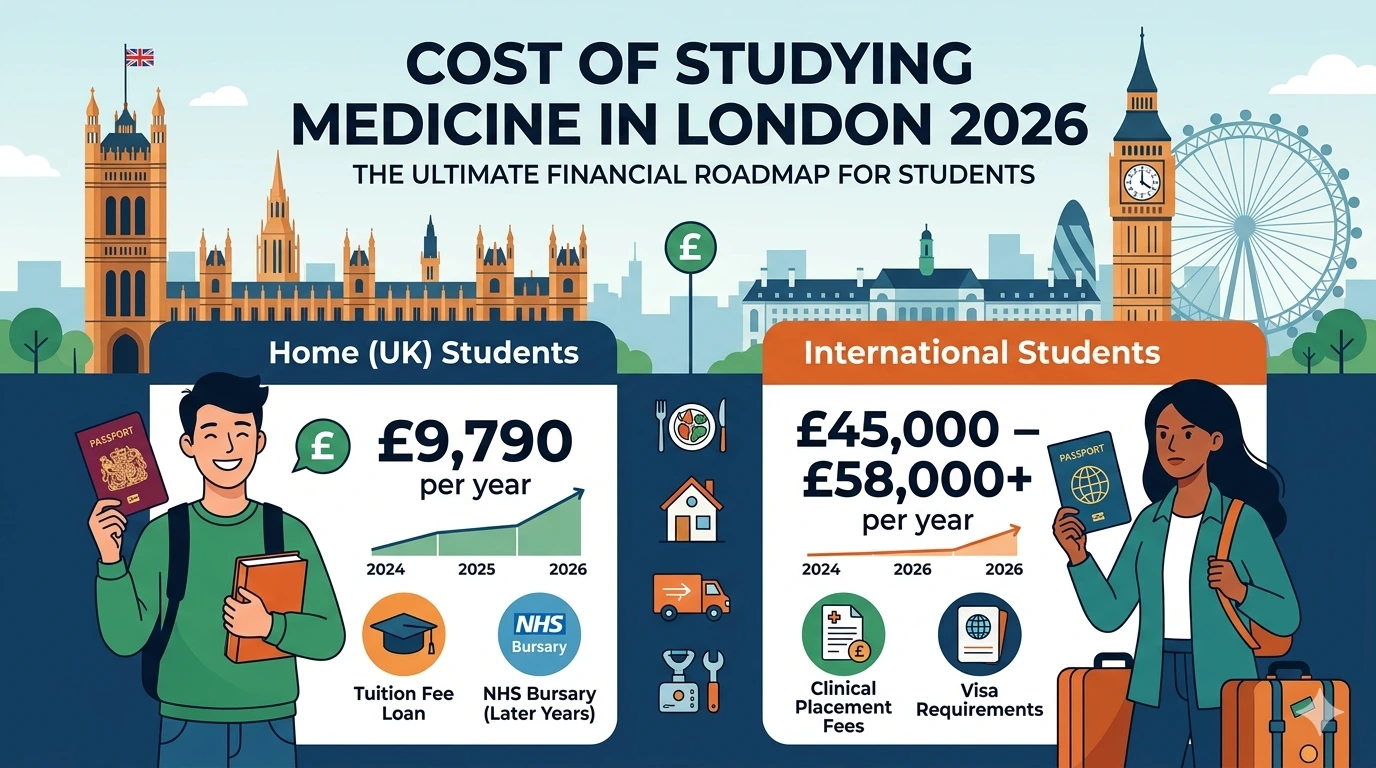
The primary component of the cost of studying medicine in London 2026 is the annual tuition fee. These rates are bifurcated based on the student’s residency status.
Home (UK) Students
For the 2026 intake, the UK government has adjusted the tuition fee cap for domestic students to £9,790 per year. Most students manage this through a Tuition Fee Loan provided by Student Finance England, which covers the cost upfront.
International Students
International candidates face significantly higher fees due to the intensive resources required for clinical placements. In 2026, international tuition fees for medical programs in London typically range from £45,000 to £58,500 per year.
2. Monthly Living Expenses Breakdown
Beyond the classroom, living in London requires a robust financial strategy. Medical students often face higher costs than average undergraduates due to longer term times and the need for proximity to hospitals.
| Expense Category | Monthly Estimate (2026) | Annual (12 Months) |
|---|---|---|
| Accommodation (Zone 2-3) | £1,000 – £1,400 | £12,000 – £16,800 |
| Food & Groceries | £250 – £400 | £3,000 – £4,800 |
| Transport (Student Oyster) | £120 – £170 | £1,440 – £2,040 |
| Utilities & Insurance | £90 – £130 | £1,080 – £1,560 |
| Total Cost | £1,460 – £2,100 | £17,520 – £25,200 |
3. Comparison of London Medical Schools
Selecting the right institution is a critical step in managing the cost of studying medicine in London 2026. Below are the projected annual international fees for top-tier schools:
- Imperial College London: Approximately £56,000.
- University College London (UCL): Approximately £53,500.
- King’s College London (KCL): Approximately £48,000.
- St George’s, University of London: Approximately £49,000.
4. Financial Support and NHS Bursaries
Financial relief is available, particularly for Home students in the final stages of their degree. For the 5th and 6th years of study, the NHS Student Bursary scheme typically covers tuition fees and provides a non-repayable grant to assist with living costs.
5. Hidden Costs of Clinical Training
Prospective doctors must account for “unseen” expenses that contribute to the total cost of studying medicine in London 2026:
- Diagnostic Equipment: A professional stethoscope (e.g., Littmann) costs roughly £100.
- Commuting to Placements: Some clinical rotations occur in District General Hospitals (DGHs) on the outskirts of London.
- Visa & Health Surcharge: International students must pay the Immigration Health Surcharge (IHS) of £776 annually.
6. The Insight Factor: Expert Opinion
“In 2026, we are seeing a ‘decentralization’ trend. To offset the high cost of studying medicine in London, students are increasingly choosing housing in Zone 4 or 5 and leveraging express rail links. This can save up to £4,000 annually on rent alone.” — Dr. Julian Pierce, Medical Education Strategist.
7. Pro Tips for Student Budgeting
- 18+ Student Oyster Card: Save 30% on travelcards—a necessity for hospital rotations.
- Digital Libraries: Avoid spending £500+ on textbooks by utilizing university-provided e-book access.
- NHS Travel Reimbursement: Ensure you claim back travel expenses for placements through the NHS Learning Support Fund.
8. Common Financial Mistakes to Avoid
- Underestimating Term Length: Medical years are longer (up to 45 weeks) than standard 30-week arts or science courses.
- Late Accommodation Booking: Booking in August rather than March can increase rent by 15% due to demand.
9. Frequently Asked Questions
How much does it cost to study medicine in London 2026 for international students?
On average, international students should budget between £65,000 and £82,000 per year, covering both tuition and high-end London living expenses.
Is the NHS bursary available in 2026?
Yes, the NHS bursary remains a staple for Home students entering their 5th year of medical school to assist with the rising cost of study.
Can I work a part-time job during medical school in London?
While possible, most medical schools advise a maximum of 8-10 hours per week due to the rigorous 40+ hour weekly academic and clinical schedule.
Internal and External Resources
- Internal: Detailed Guide for St George’s University London 2026
- Authority External: NHS Student Bursaries Official Portal
- Authority External: UK Visa Financial Requirements 2026



Pingback: Which is the Cheapest University in the UK for Medicine? 5 Budget Gems for 2026 - Articles Insight
Pingback: What is the Cheapest Medical Degree? 4-Year Fast-Track Routes in 2026 - Articles Insight
Pingback: St George's University London 2026 Guide: Fees, Ranking & Admission Success - Articles Insight