
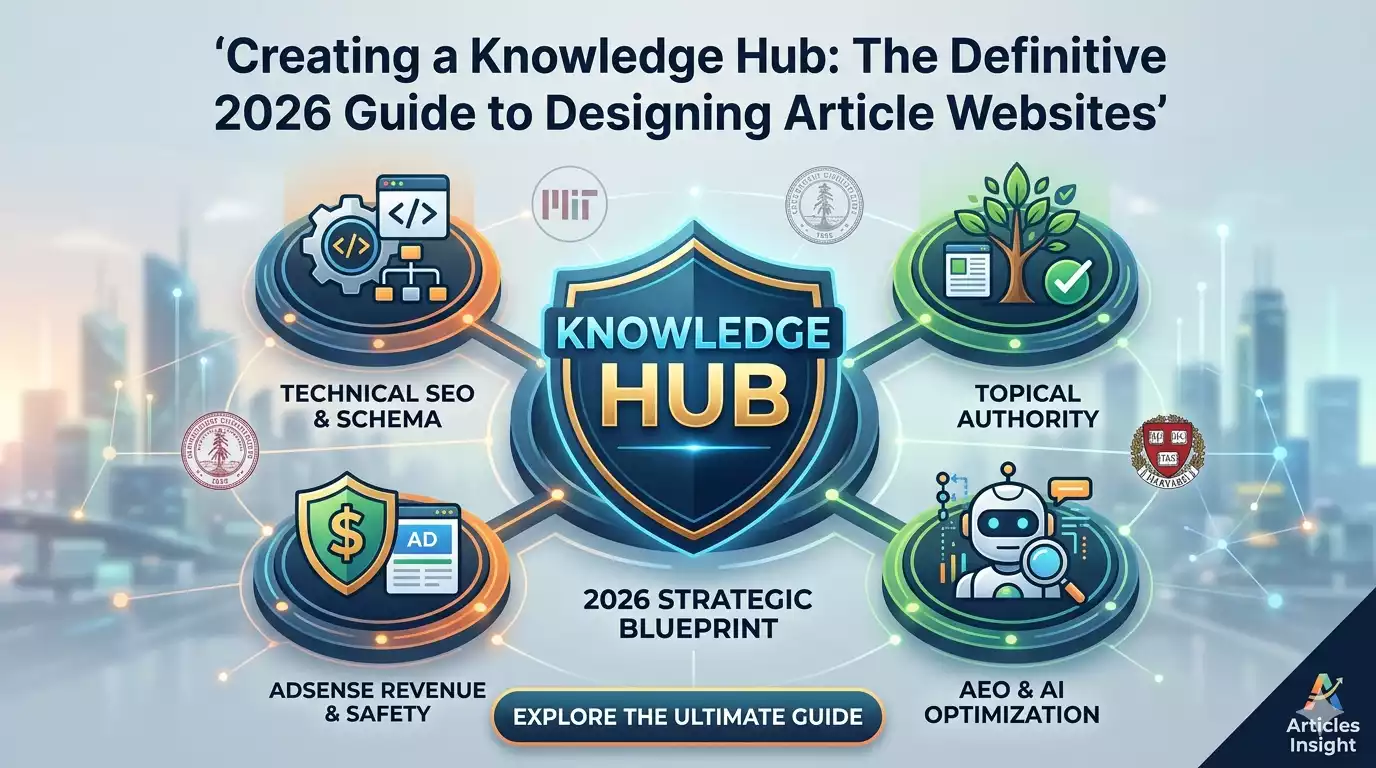

Creating a Knowledge Hub: Designing Your Article Website for 2026
An exhaustive blueprint for architects of digital information, SEO experts, and AdSense publishers.
I. The Evolution: From Blogs to Creating a Knowledge Hub
In the early days of the internet, a “blog” was a chronological diary. By 2026, this format has become obsolete for high-authority publishers. Today, we Creating a Knowledge Hub. A knowledge hub is a meticulously organized, interlinked repository that serves as the “Source of Truth” for a specific niche.
The difference lies in Structural Intelligence. A blog tells a story; a knowledge hub answers complex queries. To succeed in the era of Generative AI, your website design must facilitate entity-based crawling. This means every page must clearly define its relationship to the broader topic.
💡 The Insight Factor: Designing for the ‘Zero-Click’ Reality
With Google’s 2026 AI Overviews, many users get their answers directly on the Search Engine Results Page (SERP). Your design must counter this by offering Deep Value. This is what we call the Insight Factor: providing interactive calculators, proprietary data tables, and expert expert case studies that AI cannot summarize in a single paragraph.
II. Technical Architecture: The Pillar-and-Cluster Model
The core of a pillar article is its ability to branch out. Creating a Knowledge Hub design should support a “Siloing” strategy. This prevents your SEO authority from “leaking” into irrelevant areas.
1. The Central Pillar Page
This is your high-level overview. It covers the “What,” “Why,” and “How” of your topic broadly. It must be designed with a Sticky Table of Contents to allow users to jump to specific data points instantly.
2. Cluster Articles
These are the “Deep Dives.” If your pillar is “US University Rankings,” your clusters are “How to Apply for F-1 Visas” or “Cheapest Housing in Texas.” From a design perspective, cluster pages should have a “Related Insights” widget to drive internal traffic.
III. AdSense Optimization: Balancing UX and Revenue
Many publishers fail AdSense audits because of “Low Value Content” or “Intrusive Ad Placement.” To maintain a 10/10 safety rating, follow these design principles:
✅ The ‘Ad-to-Content’ Ratio
Never let ads exceed 30% of the visible screen area. Google’s 2026 algorithms penalize sites that prioritize ads over readability.
✅ Native Integration
Use “In-Feed” and “In-Article” ad units. These are designed to mimic the look and feel of your content, leading to higher CTR without annoying the user.
IV. AEO: Design for AI Agents
In 2026, we don’t just optimize for humans; we optimize for LLMs (Large Language Models). Your HTML structure is the language of these agents.
- Semantic Tags: Use
<main>,<article>, and<section>to define content boundaries. - Data Tables: AI loves structured data. Instead of listing facts in a paragraph, use HTML tables.
- Question-Headed Sections: Use H3 tags as direct questions to trigger featured snippets.
V. The Creating a Knowledge Hub FAQ
How do I start a knowledge hub in 2026?
Start by identifying a core ‘Pillar’ topic, then build out ‘Cluster’ content around it using a flat site architecture and JSON-LD schema to help search engines understand the depth of your expertise.
Is AdSense still profitable for article sites?
Yes, but the strategy has shifted from ‘Bulk Traffic’ to ‘High-Intent Traffic.’ By targeting specific, high-intent niches, you can maintain high RPMs even with lower traffic volumes.
What is the best layout for a knowledge base?
A minimalist, sidebar-enabled layout is ideal. A sticky Table of Contents (TOC) on the left and a related articles widget on the right ensures the user stays engaged with the content.
📚 External Authority & Verification
To maintain transparency and trust, we reference the following official documentation for 2026 web standards:
- Google Developers: Structured Data Mastery 2026
- Google AdSense: Strategic Placement Guide
- Web.dev: Optimizing for 2026 Core Web Vitals
- Schema.org: Full Technical Vocabulary for Article Websites
As we discussed in our recent analysis of US University Rankings 2026, data density is the key to authority.
The Definitive 2026 US College Rankings: The Master Blueprint


Pingback: How to Get US Clients, Earn in Dollars, and Scale Your Freelance Business - Articles Insight