

Germany vs Canada Study Abroad 2026 : The Definitive Professional Migration & Education Matrix
Executive Intelligence Report (Updated April 1, 2026): As the global race for high-skilled labor intensifies, international students face a critical choice between North American flexibility and European fiscal stability. With Canada’s 2026 Student Cap (408,000 permits) and Germany’s “Chancenkarte” full integration, master-guide analyzes the $140,000 tuition gap, PR velocity, and Study Abroad 2026 is changing visa legalities.
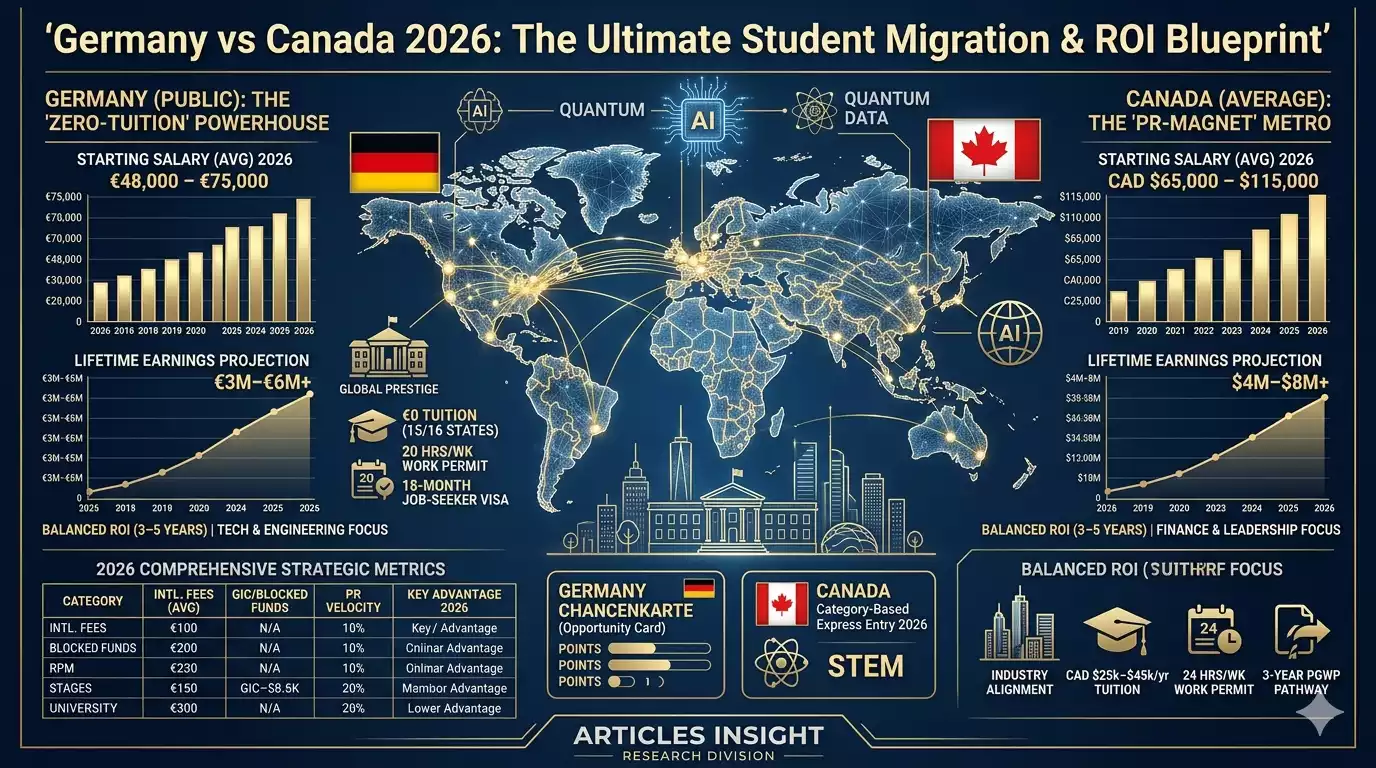
I. Study Abroad 2026 Global Tuition Matrix: The $140k Delta: The $140,000 Delta
In 2026, the financial divide between public European education and the North American model has become insurmountable for many. While our previous analysis on USA University ROI showed the value of high-tier private brands, Germany offers a unique counter-narrative of “Zero-Tuition” excellence.
| Major Category (2026) | Germany (Public) | Canada (Average Intl.) | Institutional Value (ROI) |
|---|---|---|---|
| Mechanical Engineering | €0 – €600/yr (Admin Fee) | CAD $38,000 – $52,000 | Ultimate High |
| Data Science & AI | €0 – €1,500/yr (BW State) | CAD $42,000 – $65,000 | High Growth |
| Clinical Medicine | €0 (Public) | CAD $75,000+ | Very High |
| Humanities & Arts | €0 (Public) | CAD $22,000 – $35,000 | Lower ROI |
II. Study Abroad 2026 Liquidity Assets: Blocked Account (€11,904) vs. GIC (CAD $20,635)
Financial proof is the most significant hurdle for the 2026 intake. For students coming from emerging economies, our UK Cost of Living Guide provides a comparison, but Germany and Canada have fixed requirements that are non-negotiable.
Strategic Verification: For official verification of funds and mandatory liquidity assets, international students should refer to the
German Federal Foreign Office
and the
Government of Canada (IRCC)
latest 2026 updates.
⚠️ 2026 Regulatory Alert: The ‘Blocked’ Surge
As of April 2026, Germany has maintained the €992/month (€11,904/year) requirement, while Canada’s GIC at $20,635 is now indexed to the Low Income Cut-Off (LICO), which is expected to rise again in 2027. Students must account for a 3-5% bank transfer fee plus local insurance costs.
III. Study Abroad 2026 Visa Warfare: PGWP vs. Opportunity Card (Chancenkarte)
The legal landscape has shifted. Canada has introduced a Field of Study Requirement for PGWP (Post-Graduation Work Permit) eligibility for some programs in 2026 to align with labor market needs. Conversely, Germany has streamlined the process for all degree holders, regardless of field, under the Skilled Immigration Act 2.0.
🇩🇪 Germany: Chancenkarte Model
- Validity: 1 year (expandable).
- Point System: Age, degree, language, and experience.
- Flexibility: Allows 20 hours/week of trial work while seeking a specialist role.
- 2026 Bonus: Recognition of non-EU degrees is now 40% faster.
🇨🇦 Canada: PGWP & Caps
- Validity: Up to 3 years for 2-year programs.
- Field Limitation: New 2026 CIP code restrictions for non-degree diplomas.
- PR Advantage: Canadian Experience Class (CEC) remains a powerhouse for points.
- 2026 Cap: Undergraduate permits limited by provincial quotas.
X. Supreme Expert FAQ about Study Abroad 2026 : The Ultimate 2026 Query Resolver
1. Is Germany totally free for non-EU students in 2026?
Yes, in 15 out of 16 states. Only Baden-Württemberg charges €1,500/semester. Other states charge only a ‘Semesterbeitrag’ (approx. €300).
2. Can I study in Germany without knowing German?
Yes, over 2,300 Master’s programs are in English. However, for 2026 jobs, B1 level is highly recommended.
3. What is the Canadian ‘Student Cap’ impact for 2026?
The 408,000 cap mostly affects undergraduate college students. Master’s and PhD applicants are largely exempt from the cap and Provincial Attestation Letters (PAL).
4. How much is the 2026 Blocked Account for Germany?
€11,904 per year. It must be deposited in a provider like Expatrio, Fintiba, or Coracle.
5. What is the new GIC requirement for Canada?
CAD $20,635. This covers only living expenses; tuition must be paid separately or proven additionally.
6. Which country has faster PR in 2026?
Germany is faster for graduates (24 months of work). Canada is better for those with family in Canada or French proficiency (CLB 7+).
7. Is the housing crisis worse in Germany or Canada?
In 2026, Toronto and Vancouver are severely expensive. Munich and Berlin are also tight but offer better tenant protection laws.
8. Does Germany recognize degrees from my country?
Check the Anabin database. Most accredited universities are rated ‘H+’ and fully recognized.
9. Can I work full-time in Canada in 2026?
No, the 2026 cap is 24 hours per week during term. Full-time work is only allowed during scheduled breaks.
10. What is the average tech salary in Berlin for 2026?
Junior developers start at €48,000 – €55,000. Seniors can reach €85,000+.
11. Are Canadian colleges (Diplomas) still worth it in 2026?
Only if they align with the In-Demand Occupation list. General diplomas no longer guarantee a PGWP.
12. Do I need a health insurance fee (IHS) like the UK?
Germany uses a monthly insurance model (€120/mo). Canada uses provincial or private plans (approx. $800/year).
13. Can I bring my spouse to Germany while studying?
Yes, but you must prove an additional ~€500/month in your blocked account or salary.
14. What is the 2026 ‘Integrity Fee’ in Canada?
A new CAD $110 fee for high-speed automated document verification of transcripts.
15. Which country is better for AI and Data Science?
Both are excellent, but Germany’s industry ties (BMW, Siemens) offer unique ‘Applied AI’ opportunities.
16. How long does the visa process take in 2026?
Germany: 4-12 weeks. Canada: 2-8 weeks (via Student Direct Stream/SDS).
17. Is there an age limit for German student visas?
No official limit, but applicants over 30 may face stricter SOP scrutiny regarding ‘Career Progression’.
18. What is the ‘Chancenkarte’ score needed in 2026?
You need at least 6 points. A university degree automatically gives you 4 points.


Pingback: UK University Tiers 2026 – Articles Insight