

Oxford vs Cambridge for Physics 2026: Introduction
Choosing between Oxford vs Cambridge for Physics is one of the most important academic decisions for high-achieving students planning to study Physics in the United Kingdom. Both universities rank among the top institutions globally, and both offer world-class training in theoretical and experimental physics.
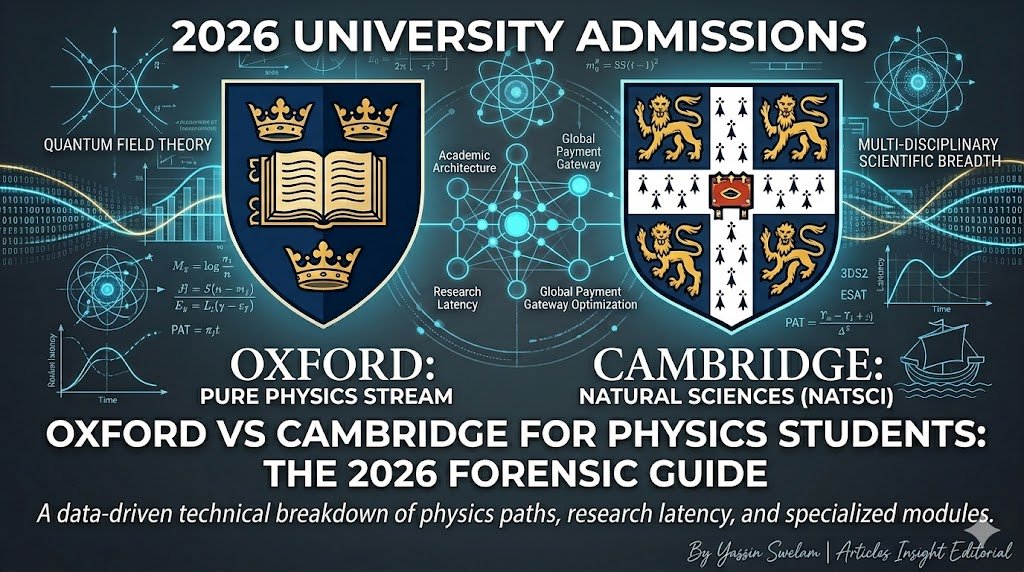
However, the differences between them are not small. They reflect two completely different educational philosophies: Oxford emphasizes early specialization and structured departmental learning, while Cambridge focuses on interdisciplinary scientific exploration through its Natural Sciences framework.
This guide provides a complete 2026 breakdown of Oxford vs Cambridge for Physics, covering academic structure, mathematics, admissions tests, research opportunities, and long-term career outcomes.
Oxford vs Cambridge for Physics: High-Level Overview
At a high level, the debate around Oxford vs Cambridge for Physics comes down to one core question: do you prefer depth early, or breadth first?
Oxford introduces Physics as a focused subject from the first year. Students immediately engage with core Physics topics such as mechanics, electromagnetism, and quantum theory in a structured environment.
Cambridge, on the other hand, places Physics inside the broader Natural Sciences Tripos. Students study Physics alongside Chemistry, Mathematics, and other sciences before specializing later.
Both pathways lead to equally respected degrees, but the student experience differs significantly depending on academic personality and learning style.
Academic Structure in Oxford vs Cambridge for Physics
One of the most important distinctions in Oxford vs Cambridge for Physics is the academic structure of the degree itself.
At Cambridge, Physics is part of the Natural Sciences Tripos in the first year. This system allows students to explore multiple scientific disciplines before choosing a specialization. The benefit of this approach is intellectual flexibility and broader scientific awareness.
Students are exposed to experimental techniques, mathematical foundations, and interdisciplinary connections early in their academic journey. This is particularly useful for students who are not yet fully committed to a single scientific direction.
Oxford takes a more direct and specialized approach. From the beginning of the degree, students study Physics in a focused environment within the Department of Physics. There is less subject dispersion and more concentrated study of Physics principles.
This structure suits students who already have a strong commitment to Physics and want to dive deeply into the subject without delay.
In the context of Oxford vs Cambridge for Physics, this is the most fundamental structural difference between the two universities.
Mathematical Rigor in Oxford vs Cambridge for Physics
Mathematics is the backbone of Physics, and in the debate of Oxford vs Cambridge for Physics, both universities are known for extreme mathematical rigor.
Cambridge is globally recognized for its deep theoretical mathematical culture. The Physics program is closely connected to advanced mathematical concepts, particularly in areas such as quantum mechanics, relativity, and theoretical modeling.
Many students find Cambridge more mathematically intense due to its strong emphasis on abstraction and theoretical derivation.
Oxford also maintains a very high mathematical standard, but its teaching style often emphasizes application and physical interpretation rather than purely theoretical development.
Students are frequently encouraged to apply mathematics to real-world physical systems and experimental contexts.
When evaluating Oxford vs Cambridge for Physics, Cambridge tends to appeal more to students interested in theoretical Physics, while Oxford attracts those interested in applied Physics and experimental work.
Admissions Requirements for Oxford vs Cambridge for Physics
Admissions for both universities are extremely competitive, and understanding the process is critical in the context of Oxford vs Cambridge for Physics.
Oxford requires applicants to take the PAT (Physics Aptitude Test). This exam focuses on problem-solving ability, mathematical reasoning, and Physics understanding.
Cambridge requires the ESAT (Engineering and Science Admissions Test), which evaluates scientific reasoning and mathematical ability across multiple domains.
Both universities also require:
- Top academic grades (usually A*A*A or equivalent)
- Strong performance in interviews
- High-level problem-solving ability
In Oxford vs Cambridge for Physics admissions, the key difference is not difficulty, but style of assessment.
Early Insight: Which Is Better?
At this stage of the comparison, it becomes clear that Oxford vs Cambridge for Physics is not about which university is objectively better, but about which environment fits the student better.
Oxford offers clarity, structure, and early focus on Physics.
Cambridge offers flexibility, breadth, and deeper theoretical exploration.
The decision depends entirely on academic personality, learning style, and long-term scientific goals.
Research Opportunities in Oxford vs Cambridge for Physics
Research is a key factor when evaluating Oxford vs Cambridge for Physics, especially for students who plan to pursue academic or scientific careers after graduation.
Oxford has a strong reputation in experimental physics, with world-class laboratories and strong connections to applied research in fields such as quantum technology, particle physics, and astrophysics.
Cambridge, on the other hand, has historically dominated theoretical physics and mathematical physics research. The Cavendish Laboratory is one of the most influential physics research institutions in the world.
In terms of Oxford vs Cambridge for Physics, both universities offer direct access to cutting-edge research, but in different scientific directions.
Student Experience in Oxford vs Cambridge for Physics
The student experience is another important factor in choosing between Oxford vs Cambridge for Physics.
Oxford operates on a department-centered system where students receive structured teaching, tutorials, and close academic supervision. This creates a highly focused and intensive academic environment.
Cambridge uses a college-based system with supervisions (small-group teaching sessions). This system is more flexible and often encourages broader intellectual exploration.
Both systems are academically demanding, but they shape student life differently. Oxford tends to feel more centralized and structured, while Cambridge feels more distributed and exploratory.
Career Outcomes in Oxford vs Cambridge for Physics
Graduates from both universities achieve exceptional career outcomes, making Oxford vs Cambridge for Physics one of the strongest academic choices globally.
Common career paths include:
- Theoretical Physics research
- Engineering and technology roles
- Data science and machine learning
- Financial modeling and quantitative analysis
- Academic research and PhD programs
Employers worldwide recognize both degrees equally, meaning that the decision in Oxford vs Cambridge for Physics has more impact on student experience than career limitations.
Alternatives to Oxford vs Cambridge for Physics
While Oxford vs Cambridge for Physics dominates global rankings, several other UK universities also offer strong Physics programs.
Institutions such as Imperial College London, University of St Andrews, and University of Manchester provide excellent alternatives with strong research output and modern facilities.
For some students, these universities may offer better specialization opportunities or more flexible admissions criteria.
FAQ: Oxford vs Cambridge for Physics
Which is better for theoretical Physics?
Cambridge is generally stronger in theoretical Physics due to its deep mathematical tradition and research focus.
Which is better for experimental Physics?
Oxford is often considered stronger in experimental Physics, with advanced laboratory facilities and applied research programs.
Is Oxford vs Cambridge for Physics very competitive?
Yes. Both universities are among the most competitive Physics programs in the world, requiring exceptional academic performance and strong problem-solving skills.
What is the main difference between Oxford and Cambridge Physics?
The main difference in Oxford vs Cambridge for Physics is structure: Oxford specializes early, while Cambridge provides broader scientific training before specialization.
Final SEO Conclusion: Oxford vs Cambridge for Physics 2026
Ultimately, Oxford vs Cambridge for Physics is not about choosing the “best” university, but about choosing the best learning environment for your academic personality.
Oxford is ideal for students who want structured, focused Physics training from the beginning of their degree. Cambridge is ideal for students who prefer broader scientific exploration and deeper theoretical development.
Both universities produce world-class physicists, researchers, and industry leaders. The difference lies in approach, not quality.
For most applicants, the best decision in Oxford vs Cambridge for Physics comes down to whether they value specialization or interdisciplinary scientific depth.
Both paths lead to the same destination: excellence in Physics.
For a deeper understanding , see our
Ultimate UK University Ranking Guide (March 2026 Update)