

St George’s University Tuition Fees 2026: Full Cost Breakdown for International Students
Understanding St George’s University tuition fees is essential for any student planning to study medicine in the UK. SGUL is one of the most respected medical schools in London, and its cost structure reflects the intensity of clinical training and hospital-based education.
This guide breaks down everything: tuition fees, living costs, hidden expenses, and the real total cost of studying at SGUL in 2026.
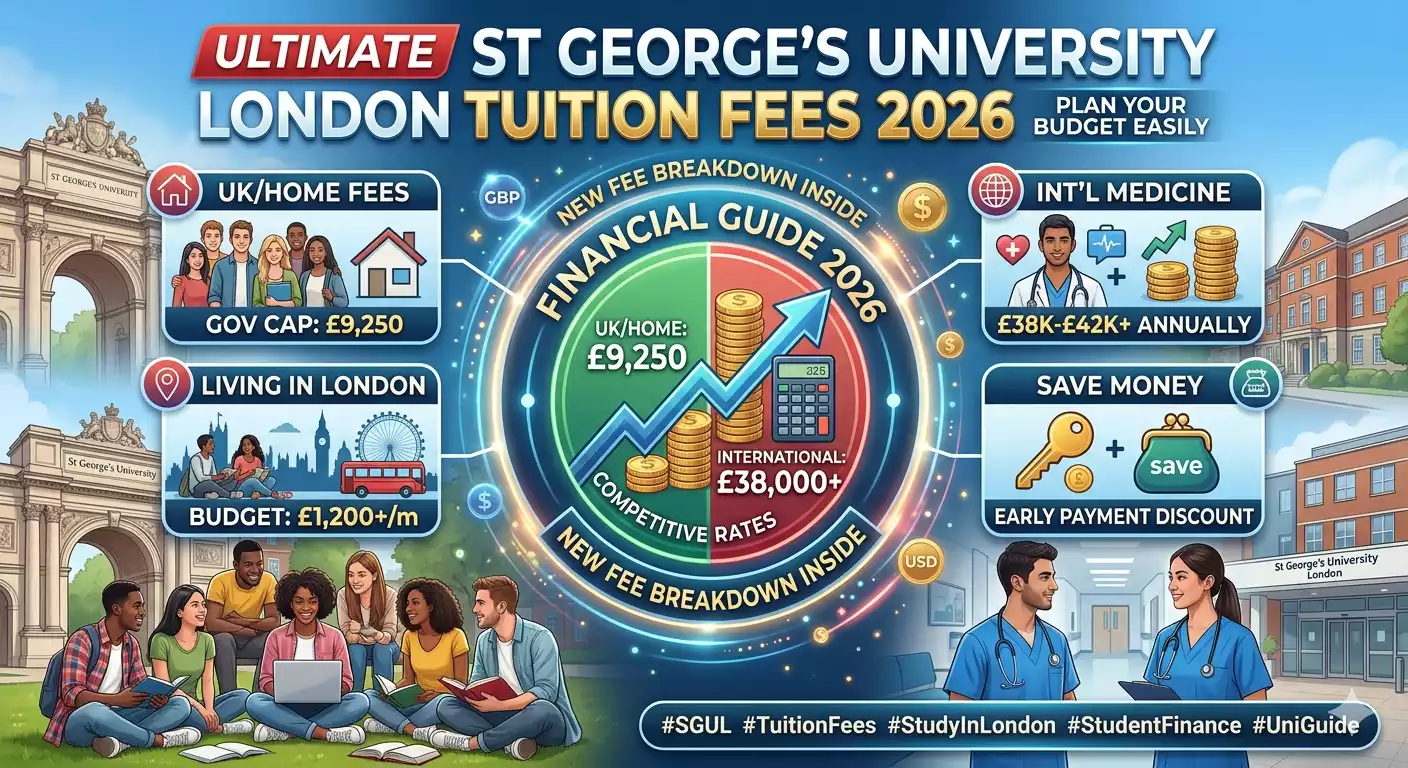
Table of Contents
| Section | Details |
|---|---|
| Overview | Understanding SGUL cost structure |
| Tuition Fees | MBBS and programs cost |
| Living Costs | London expenses |
| Hidden Costs | Extra academic expenses |
St George’s University tuition fees Overview for International Students
The St George’s University tuition fees vary depending on the program, but Medicine (MBBS) is the most expensive due to its clinical nature.
Unlike many universities, SGUL is directly connected to a teaching hospital, meaning students gain early real-world experience — but this also increases operational costs.
For international students, fees are significantly higher than UK students, which is standard across British medical schools.
St George’s University tuition fees 2026 Full Breakdown for MBBS Students
| Program | Annual Fees | Duration |
|---|---|---|
| MBBS Medicine | £38,000 – £45,000 | 5–6 Years |
| Biomedical Sciences | £17,000 – £22,000 | 3 Years |
| Postgraduate Courses | £20,000 – £35,000 | 1–2 Years |
The St George’s University fees for Medicine are among the highest in the UK, but they reflect the quality of clinical training provided.
St George’s University tuition fees Overview for International Students 2026
There are several reasons behind the high SGUN tuition fees:
- Hospital-based teaching model
- High-cost medical equipment and labs
- Clinical supervision by NHS doctors
- London location costs
Medical education requires real patient interaction, which makes it significantly more expensive than other degrees.
Living Costs in London
In addition to SGUN tuition fees, students must consider living costs in London — one of the most expensive cities in Europe.
| Expense | Monthly Cost |
|---|---|
| Accommodation | £800 – £1400 |
| Food | £250 – £400 |
| Transport | £100 – £200 |
| Personal Expenses | £150 – £300 |
Total monthly living cost: £1200 – £2000.
Hidden Costs Students Don’t Expect
- Medical equipment (lab coats, tools)
- Books and digital resources
- Travel for hospital placements
- Exam and registration fees
These costs add up and significantly increase the total burden of studying at SGUL.
SGUL Tuition Fees Compared to Other UK Medical Schools
To fully understand St George’s University tuition fees, we need to compare them with other UK medical universities. This helps students evaluate whether SGUL is expensive, average, or cost-effective within the UK medical education system.
| University | Medicine Fees (Annual) | Cost Level |
|---|---|---|
| St George’s University of London | £38,000 – £45,000 | High |
| University College London (UCL) | £40,000 – £52,000 | Very High |
| King’s College London | £38,000 – £55,000 | Very High |
| University of Manchester | £35,000 – £45,000 | High |
From this comparison, St George’s University tuition fees are within the standard range for London-based medical schools. The cost is high, but not unusually expensive compared to competitors.
Is SGUL Worth the Tuition Fees?
A critical question for students is whether St George’s University tuition fees are worth the investment.
The answer depends on your long-term goals. SGUL is not just a university — it is a clinical training environment integrated with NHS hospitals.
Main Advantages
- Early clinical exposure from first years
- Strong NHS hospital integration
- High employability after graduation
- Global recognition in medicine
These factors increase the long-term value of the degree despite high tuition costs.
Return on Investment (ROI) of St George’s University tuition fees 2026
When analyzing St George’s University tuition fees, ROI is extremely important because medicine is a long-term career path.
| Career Stage | Income Range |
|---|---|
| Foundation Doctor | £30,000 – £40,000 |
| Specialist Doctor | £60,000 – £100,000+ |
| Consultant Level | £90,000 – £150,000+ |
Although initial salaries are modest, long-term earning potential is very strong in medicine.
This means St George’s University tuition fees should be seen as a long-term investment rather than a short-term expense.
Scholarships and Financial Support
SGUL offers limited financial aid options, which can slightly reduce the burden of St George’s University tuition fees.
Available Options
- Merit-based scholarships
- Hardship funding (limited availability)
- External funding opportunities
However, competition for scholarships is extremely high, and most international students rely on self-funding.
How to Reduce Overall Study Costs
Even though St George’s University tuition fees are fixed, students can reduce total expenses through smart planning.
1. Choose Affordable Housing
Shared accommodation can reduce costs significantly compared to private housing.
2. Budget Living Expenses
Careful monthly budgeting can reduce unnecessary spending in London.
3. Part-Time Work
International students can work up to 20 hours per week during term time.
| Strategy | Estimated Savings |
|---|---|
| Shared Housing | £200–£500/month |
| Part-Time Work | £600–£900/month |
| Budget Control | £100–£300/month |
Who Should Choose SGUL Despite High Fees?
Not all students should apply to SGUL. The decision should be based on commitment and financial readiness.
Ideal Candidates
- Students fully committed to medicine
- Students aiming for UK or global medical careers
- Students able to handle academic pressure
Not Suitable For
- Students unsure about medicine
- Students looking for low-cost education
- Students avoiding long-term study commitments
Ultimately, St George’s University tuition fees are justified only for students with serious medical career goals.
St George’s University tuition fees: Total Cost of Studying Medicine (5–6 Years)
When calculating St George’s University tuition fees, students often focus only on annual tuition. However, the real cost of studying medicine at SGUL must include the full duration of the program, which typically lasts 5 to 6 years.
Full Cost Breakdown
| Cost Component | Estimated Total (5–6 Years) |
|---|---|
| Tuition Fees | £190,000 – £270,000 |
| Living Costs (London) | £70,000 – £120,000 |
| Study Materials & Exams | £5,000 – £10,000 |
| Total Estimated Cost | £265,000 – £400,000+ |
This shows that St George’s University tuition fees represent only part of the total financial commitment required to complete a medical degree in London.
Hidden Long-Term Costs
Many students underestimate the full financial burden because they ignore additional costs beyond tuition.
- Clinical placement travel costs
- Medical equipment and uniforms
- Exam resits and registration fees
- Visa renewals and administrative charges
These hidden expenses can significantly increase the total cost of studying at SGUL over time.
Long-Term Financial Perspective
Medicine is unique compared to other degrees because the return on investment is delayed but stable.
| Stage | Financial Situation |
|---|---|
| During Study | High cost, no income |
| Foundation Training | Low–moderate salary |
| Specialist Level | High earning potential |
Although The cost of studying medicine at SGUL is high, the long-term career stability in medicine makes the investment logical for committed students.
External References (Important for SEO)
Frequently Asked Questions (FAQ)
1. What are St George’s University tuition fees for medicine?
Between £38,000 and £45,000 per year for MBBS.
2. What is the total cost of studying at SGUL?
Between £265,000 and £400,000+ including living expenses.
3. Is SGUL expensive compared to other UK universities?
Yes, but it is consistent with London medical schools.
4. Can international students afford SGUL?
Yes, but strong financial planning is required.
5. Are scholarships available?
Limited merit-based scholarships exist.
6. Can students work while studying?
Yes, up to 20 hours per week during term time.
7. Is SGUL worth the cost?
Yes for students committed to a medical career.
8. Do fees increase yearly?
Slight annual increases may occur.
9. What is the biggest hidden cost?
Living expenses in London.
10. Is SGUL cheaper than UCL or King’s?
It is similar but sometimes slightly lower.
Final Verdict
St George’s University tuition fees are high, but they reflect the quality of medical training, hospital integration, and career outcomes offered by the university.
For serious medical students, SGUL is not just an expense — it is a long-term professional investment.
Bottom line: High cost, but strong medical career return.
Related Articles (SGUL Cluster)
- Complete SGUL Guide 2026
- SGUL Acceptance Rate 2026 Analysis
- Admission Requirements Guide
- How to Apply to SGUL
Final Analysis of St George’s University tuition fees in 2026
When evaluating St George’s University tuition fees in 2026, it becomes clear that the cost reflects more than just academic instruction. It represents access to a highly structured medical training system integrated with NHS hospitals, early clinical exposure, and internationally recognized qualifications.
While the financial commitment is significant, especially for international students, the value of studying medicine at SGUL is closely tied to long-term career outcomes rather than short-term affordability. Students are not simply paying for lectures; they are investing in a full clinical education pathway that prepares them for real-world medical practice.
From a financial perspective, St George’s University tuition fees should be viewed as part of a broader investment strategy. Medicine is a long-duration career path where earnings typically increase substantially after graduation and specialization. This shifts the conversation from “cost” to “return on investment”.
However, it is also important to be realistic. The total cost of studying in London — including tuition, accommodation, transport, and living expenses — places SGUL among the more expensive options in the UK. For this reason, financial planning is not optional; it is essential.
In conclusion, St George’s University tuition fees are justified for students who are fully committed to pursuing a medical career and are prepared for the academic and financial demands of studying in one of the most competitive healthcare education environments in the UK.
For those students, SGUL offers a clear pathway into the medical profession with strong employability, clinical exposure, and global recognition.





Pingback: St George’s University Admission Requirements for International Students (2026 Success) - Articles Insight
Pingback: St George’s University Acceptance Rate 2026: Ultimate Guide for International Students Explained - Articles Insight
Pingback: How to Apply to St George’s University London 2026: A Proven Step-by-Step Guide for Fast Approval - Articles Insight
Pingback: St George’s University London 2026 Guide: Fees, Ranking & Admission Success - Articles Insight